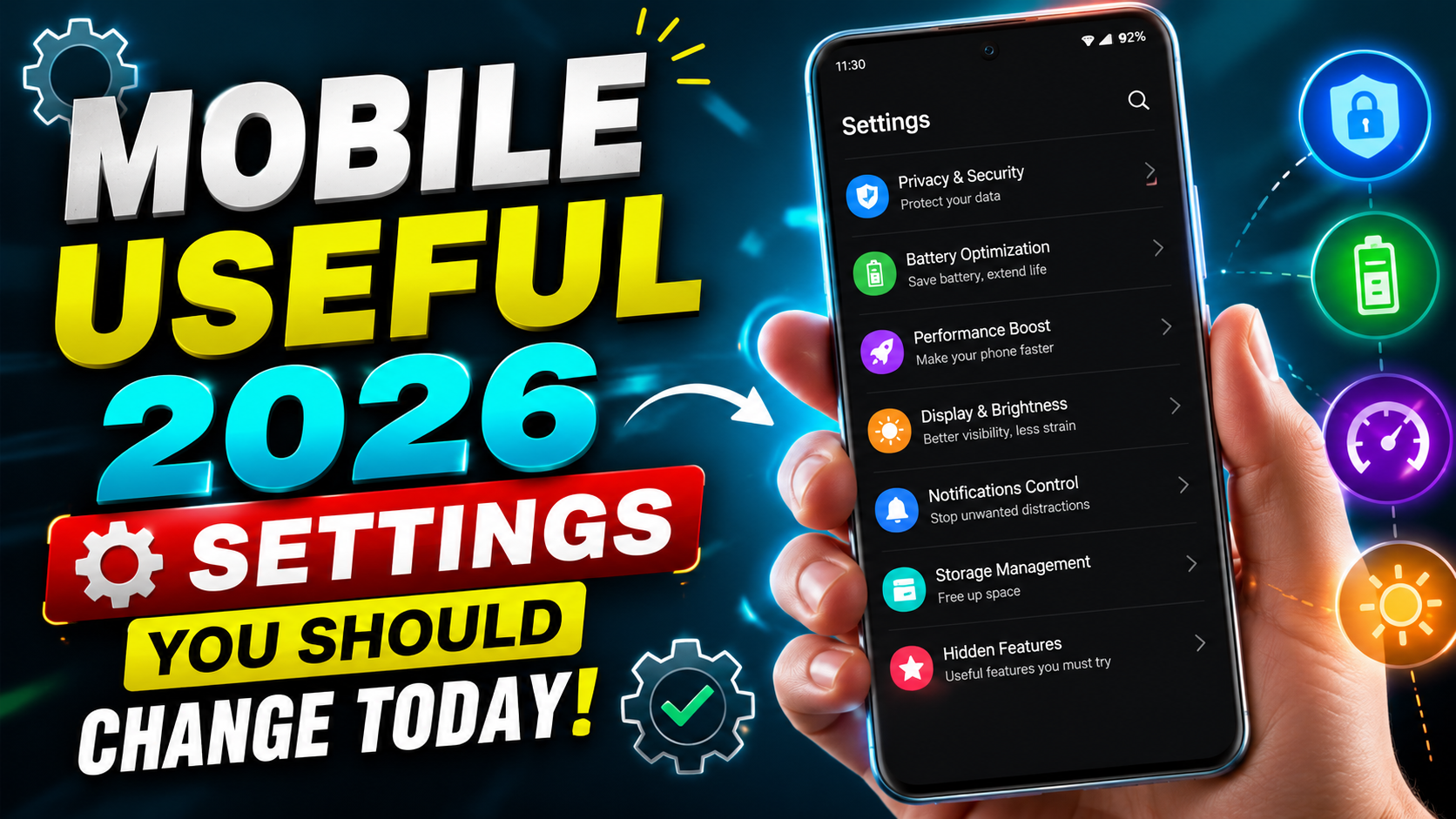
Hello friends, today we are going to explore some mobile useful 2026 settings that most people ignore but really should not. Many phones are now packed with AI options, privacy tools, and battery modes, yet the default setup often wastes power, shares more data than you like, and pulls your attention all day.
This article will help you turn those hidden options into something practical. We will walk through the most important settings to review on a modern Android phone in 2026, with simple explanations and safe starting points. You will not need root access or special tricks, only the normal settings app and a few minutes.
The guide is written for everyday users who do calls, social apps, short video, banking, and a bit of work on the same device. If you are not a tech expert but you care about battery life, privacy, and fewer distractions, these setting ideas are for you. Power users can still use this as a checklist when setting up any new phone.
Different brands like Samsung, Xiaomi, OnePlus, Pixel, and others arrange their menus slightly differently, so names may not match exactly. When that happens, use the search bar inside the Settings app and type the keyword we mention, such as battery, digital well being, or permissions. That small habit alone makes these mobile useful 2026 settings much easier to find.
Related Resource
The Download Now button above opens the Google Play page related to Mobile Useful 2026 Settings. Tap it to reach the app install page directly, so you can open the listing without searching again.
1. Privacy and permission controls you should not skip
Manufacturers have added strong privacy dashboards by 2026, but most people only see them when something goes wrong. Take five minutes and review which apps can see location, microphone, camera, and contacts.
Key steps to review
- Open Settings then Privacy or Security and privacy.
- Find Permission manager or Privacy dashboard.
- Check Location, Camera, Microphone, Contacts, Files and media.
For any social or utility app that does not really need constant access, change the permission to Only while using or Ask every time. If an app that looks simple like a flashlight or wallpaper app asks for contacts or microphone, that is a red flag you should uninstall it or at least block that permission.
Real world example, a student installs a free PDF scanner that quietly asks for location and phone call access. After checking the privacy dashboard, they remove those permissions and later replace the app with a more reputable one. That simple review prevents unnecessary data sharing while keeping the main feature working.
2. Notification tuning for a calmer home screen
By 2026, notifications are the biggest daily distraction for many users, especially with short video and shopping apps sending constant alerts. The good news is that current Android versions give detailed notification control per app and per category.
What to change
- Open Settings then Notifications.
- Go to App notifications.
- Turn off marketing or promotional channels inside each noisy app.
- Enable summary or digest mode if your phone brand offers it so non urgent alerts appear in batches.
Case study style example, a small business owner relies on WhatsApp and email for customer messages, but TikTok, shopping apps, and random news alerts keep interrupting during meetings. They keep full notifications only for calls, messaging apps, calendar, and banking. Everything else is set to silent or summary mode. Within a week focus improves and they still do not miss anything important.
3. Battery and performance modes that really matter in 2026
Many phones now include AI based performance tuning, adaptive battery, and app sleep features. Used correctly, these options can add hours of battery without killing essential background tasks like chat or fitness tracking.
Typical options and what they do
| Battery setting | What it usually does | Safe starting choice |
|---|---|---|
| Adaptive battery or Smart battery | Limits rarely used apps from running in background. | Turn on for most users. |
| Performance mode or Game mode | Boosts CPU and GPU, uses more power and heat. | Use only when gaming or editing video. |
| App sleep or Deep sleep | Freezes rarely used apps to save battery. | Add heavy apps you use once a month like airline or event apps. |
| Optimized charging or Battery protection | Slows charging overnight to protect long term battery health. | Turn on if you charge while sleeping. |
One common mistake is forcing all apps into aggressive power saving. That can delay messages from work chat or banking alerts. After you enable adaptive features, test your important apps for a day. If something stops sending timely notifications, remove it from the battery optimization list in Settings, Apps, then Special access or Battery usage.
4. AI, assistant, and on device processing choices
In 2026 many phones come with AI features like live captions, smart replies, call summaries, and voice assistants that can run on device. These can be helpful but they sometimes send data to cloud services for processing, depending on your configuration and region.
How to review AI options safely
- Open Settings then AI, Digital assistant, or Advanced features.
- Look for On device processing or Private compute settings.
- Prefer on device options where performance is good enough.
- Disable voice wake up if you are concerned about microphones listening all day.
Real world example, a remote worker uses AI transcription for meetings. They enable on device transcription for short calls, but when dealing with highly confidential discussions they still prefer manual notes or a secured laptop client, since phone AI tools may not always meet strict company policies.
5. Network, SIM, and data safety settings
Data usage and number security are easy to forget until a roaming bill or SIM hijack attempt appears. Phones in 2026 usually have better alerts but you still need to enable them.
Important network checks
- In Settings then Network and internet, turn on Data warning and limit. Set a realistic monthly cap.
- Enable Wi Fi auto reconnect only for trusted networks that you recognize.
- Turn off automatic connection to open public Wi Fi if your device includes that toggle.
- In SIM settings, enable SIM lock with a PIN from your carrier card, then store the PIN safely offline.
Also review which apps use unrestricted data. Some brands let you restrict background mobile data per app, which is useful for heavy streaming apps that you only use on Wi Fi. Just avoid restricting messaging and navigation apps that you rely on while moving.
6. Lock screen, backup, and recovery details
Security in 2026 is not just about fingerprints. A strong screen lock, verified backups, and recovery options will save you if your phone is lost or damaged.
Security essentials
- Use fingerprint or face unlock plus a long PIN or password, not simple patterns.
- Enable Find my device or similar service and confirm location access for that system app.
- Turn on automatic cloud backup for photos, contacts, and app data through Google, Samsung, or your brand account.
- Save backup codes for important accounts like email and banking in an offline place such as a written sheet in a home folder.
A common mistake is relying only on biometric unlock. If the sensor fails or you forget the backup PIN, you may need a full reset which wipes data. Testing your backup and recovery login on a second device, such as a spare phone or web browser, avoids nasty surprises later.
7. Digital wellbeing and focus tools
Phones in 2026 include time tracking and focus modes that are surprisingly powerful when you configure them at least once. These are not about quitting your apps, they help you create clear borders between work, rest, and sleep.
Simple focus setup
- Go to Settings then Digital wellbeing or Screen time.
- Check daily usage graphs for social and short video apps.
- Create one Work focus that only lets calls, messaging, and work tools send alerts.
- Create one Sleep routine that dims the screen and silences most notifications at night, while still letting alarm and emergency contacts pass through.
This small change is often more effective than uninstalling apps. You keep control but the phone stops feeling like it is shouting at you every five minutes.
Conclusion
Modern phones provide many mobile useful 2026 settings, yet almost no one uses more than a few of them. By reviewing privacy permissions, notification categories, battery modes, AI options, and recovery tools, you turn your device from a noisy gadget into a calmer and safer daily partner.
You do not need to change everything in one day. Start with permission controls and lock screen security, then move to notification cleanup and battery tweaks later in the week. A short review now can prevent bigger issues like stolen data, missed alerts, or dead battery at the wrong moment.
FAQ
How often should I review these settings on my phone
Review key privacy, battery, and security settings every three to six months, or whenever you install several new apps or a major system update arrives.
Do these tips work for both Android and iOS in 2026
The examples focus on Android where naming is more varied, but the ideas apply to iOS as well, such as checking permissions, notifications, battery health, and backups.
Can changing battery settings damage my phone
Using official battery options inside Settings is safe. The main risk is missing notifications if you over limit background activity, so test important apps after each change.
Is on device AI always more private
On device processing usually sends less data to servers, which is better for privacy, but you should still read the AI or assistant privacy notes provided by your brand.
What should I do before selling or giving away my phone
Backup data, sign out from main accounts, remove any eSIM or SIM, then run factory reset from Settings and confirm that personal files are wiped before handing it over.
Thank you for reading. If you found this useful, stay tuned and follow this blog for more latest tech news, useful apps, AI tools, and practical mobile updates that keep your devices under your control.