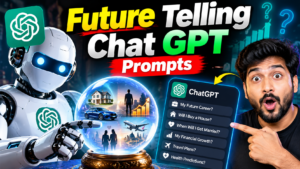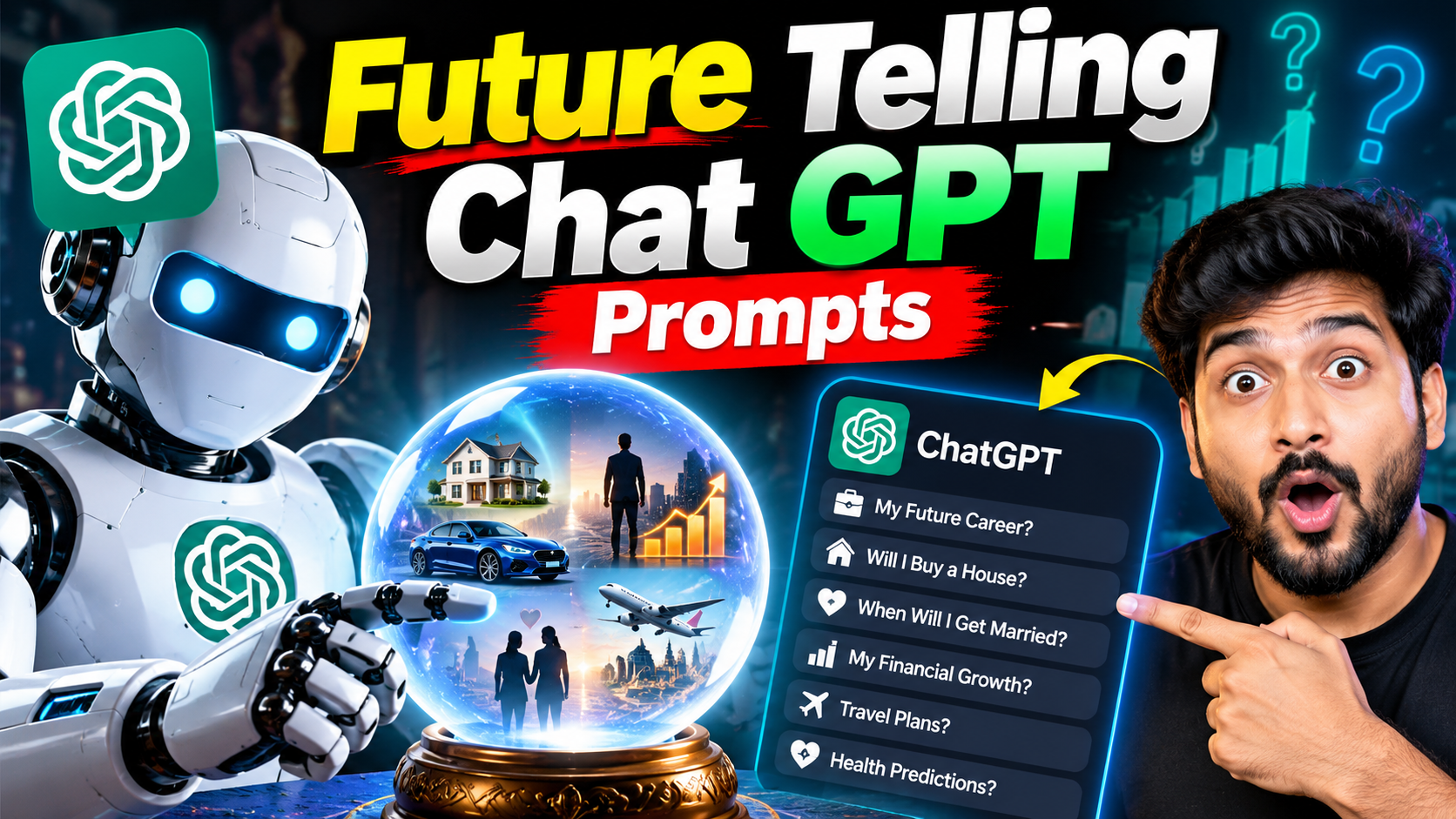
Many people open ChatGPT and immediately ask things like What will happen in 2030? or Will my startup succeed? That’s a fast way to get confident‑sounding, but unreliable answers.
ChatGPT has no access to real‑time markets, personal data, or future events. It can’t see your future. What it can do remarkably well is help you think ahead: explore scenarios, spot risks, and plan based on patterns in existing data.
This guide walks through how to write future‑oriented prompts that are useful and realistic, plus ready‑to‑paste prompt templates for planning your career, projects, and more.
1. What ChatGPT Can and Can’t Do About The Future
What it can’t do
- Predict stock prices, lottery numbers, or specific dates of events.
- Guarantee outcomes for your exam, visa, job offer, or relationship.
- Give personalised legal, medical, or financial advice that replaces a professional.
What it is good at
- Summarising existing trends (e.g., AI in education, remote work, EV adoption).
- Generating what‑if scenarios and consequences of different choices.
- Helping you build plans, checklists, and timelines for future projects.
- Translating complex reports or forecasts into plain language.
Think of ChatGPT as a scenario and planning assistant, not an oracle.
2. A Simple Formula for Future Focused Prompts
Before the examples, here’s a quick formula that keeps prompts grounded in reality:
[Context] + [Timeframe] + [Goal] + [Constraints] + [Format]
Example:
- Context: I’m a junior web developer…
- Timeframe: …planning the next 3 5 years…
- Goal: …I want to move into backend roles…
- Constraints: …I can only study 5 7 hours per week…
- Format: …create a table with yearly focus, skills, and suggested projects.
Combine them into a single prompt and you get structured, practical output instead of vague predictions.
3. Career & Skills: Planning Your Next 5 Years
Use these prompts to explore possible paths instead of asking What job will I have in 5 years?
Prompt: Skill roadmap for a specific role
I’m currently a [your current role or student status] with these skills: [list]. I’d like to be a strong [target role, e.g., data analyst] within the next [timeframe, e.g., 3 years]. Using today’s common expectations for that role (not predictions of the distant future), create a realistic learning roadmap. Include: Key skills and tools to learn Rough order to learn them Suggested small portfolio projects How to measure progress every 6 months Assume I have around [X] hours per week to study.
Prompt: Compare two future career options
Compare the next 5 7 years for these two career paths: 1) [Path A, e.g., staying in front end web development]
2) [Path B, e.g., transitioning to UX design] For each path, based on existing information (not personal predictions), outline: Typical daily work Common skills required Likely pros and cons Risks or uncertainties What I can do in the next 12 months to test if this path suits me Do NOT guess my personal future. Focus on patterns and what’s generally true today.
These prompts keep the model grounded in current patterns, while still helping you prepare for the years ahead.
4. Project & Business: Stress Testing Future Scenarios
For projects, side hustles, or early‑stage ideas, treat ChatGPT like a simulation partner. Ask it to stress‑test plans, not to declare you will succeed or you will fail.
Prompt: Scenario planning for a new project
I plan to launch [brief project or product description] targeting [audience] in [region, if relevant] within the next [timeframe]. Act as a planning assistant and: List 3 optimistic but realistic scenarios List 3 realistic middle scenarios List 3 negative scenarios and main reasons they might happen For each negative scenario, suggest 2 3 mitigation steps I can start now Base your scenarios on typical patterns for similar projects today, not guaranteed predictions.
Prompt: Early risk checklist
I’m considering starting [business or project idea] in [industry]. Create a checklist of early risks I should examine in the next 3 months, grouped under: Market risks Operational risks Legal/compliance risks Technology risks Personal/time risks For each group, give 3 5 questions I should research using trusted human sources (experts, official documents), not just AI.
5. Personal Planning: Future Habits, Not Future Predictions
ChatGPT can’t tell you who you’ll marry or when you’ll buy a house, but it can help design habits and realistic plans that make your desired outcomes more likely.
Prompt: Yearly planning with milestones
I want to design a realistic 12 month plan for [goal, e.g., improving my fitness and energy levels] starting from [current month and year]. Ask me 5 8 clarifying questions about my current situation, constraints, and preferences. Then, based on my answers, create: Quarterly milestones Monthly focus areas 3 5 simple weekly routines Objective ways to track progress Do not make promises about results. Focus on habits and measurable actions.
Prompt: Planning around uncertainties
I’m likely to face these uncertainties in the next 1 2 years: [list, e.g., possible job change, moving city, starting a family]. Help me design flexible plans by: Suggesting decisions I should delay until I have more information Highlighting decisions that are safe to make now Showing how to create Plan A / Plan B / Plan C for housing, finances, and work Use bullet points and avoid personal predictions like you will definitely get a new job.
6. Future Trends: Using ChatGPT Without Overtrusting It
Trend exploration is where many readers over‑rely on AI especially for finance, crypto, or health topics. The trick is to use ChatGPT for orientation, then go to primary sources.
Prompt: Trend overview with source suggestions
Give a plain language overview of the current state (not future predictions) of [topic, e.g., electric vehicles adoption in Europe]. Include: Key themes and challenges 3 5 types of organisations or data sources I should check (e.g., government stats agencies, industry bodies) Typical metrics people track in this area Do not invent numbers or make precise future forecasts. Instead, explain what indicators experts usually watch.
Prompt: Side‑by‑side possible futures
List 3 contrasting but plausible future scenarios for [topic, e.g., remote work in knowledge jobs over the next decade], based on existing discussions and research (no specific years or precise forecasts). For each scenario, outline: What would need to be true for it to happen Who benefits and who struggles Early warning signs or indicators to monitor Clearly label these as hypothetical scenarios, not predictions.
7. Common Mistakes With Future Prompts (And Safer Alternatives)
| Risky Prompt Style | Problem | Better Prompt Style |
| Which stock will grow the most in 2026? | Asks for financial predictions; can mislead readers. | Explain how people assess growth potential in stocks, and list common risk factors they consider. |
| Will my startup succeed? | Treats AI as a fortune teller; ignores execution and context. | Given this startup idea [briefly describe], list realistic risks, assumptions, and validation steps for the next 90 days. |
| Will I pass my exam? | No way for ChatGPT to know; can create false confidence. | Here’s my exam syllabus and current study pattern. Suggest a 4‑week revision plan and weak areas I might be missing. |
| When will [country] change its law on X? | Political/legal predictions are highly uncertain. | Summarise the current law on X and typical steps involved when a law is changed, then list official sources I should monitor. |
8. Safety, Bias, and When to Stop Relying on AI
Future‑oriented questions are exactly where AI hallucinations and bias can quietly creep in. A few rules:
- Always cross‑check anything that affects money, health, or legal status with a qualified human professional.
- Be wary of precise‑sounding numbers or dates ask: What is this based on?
- Ask ChatGPT to label uncertainty: Explain how uncertain this scenario is and what could change it.
- Remember that models are trained on historical text, which may contain bias about jobs, regions, or demographics. Challenge it if a future scenario relies on stereotypes.