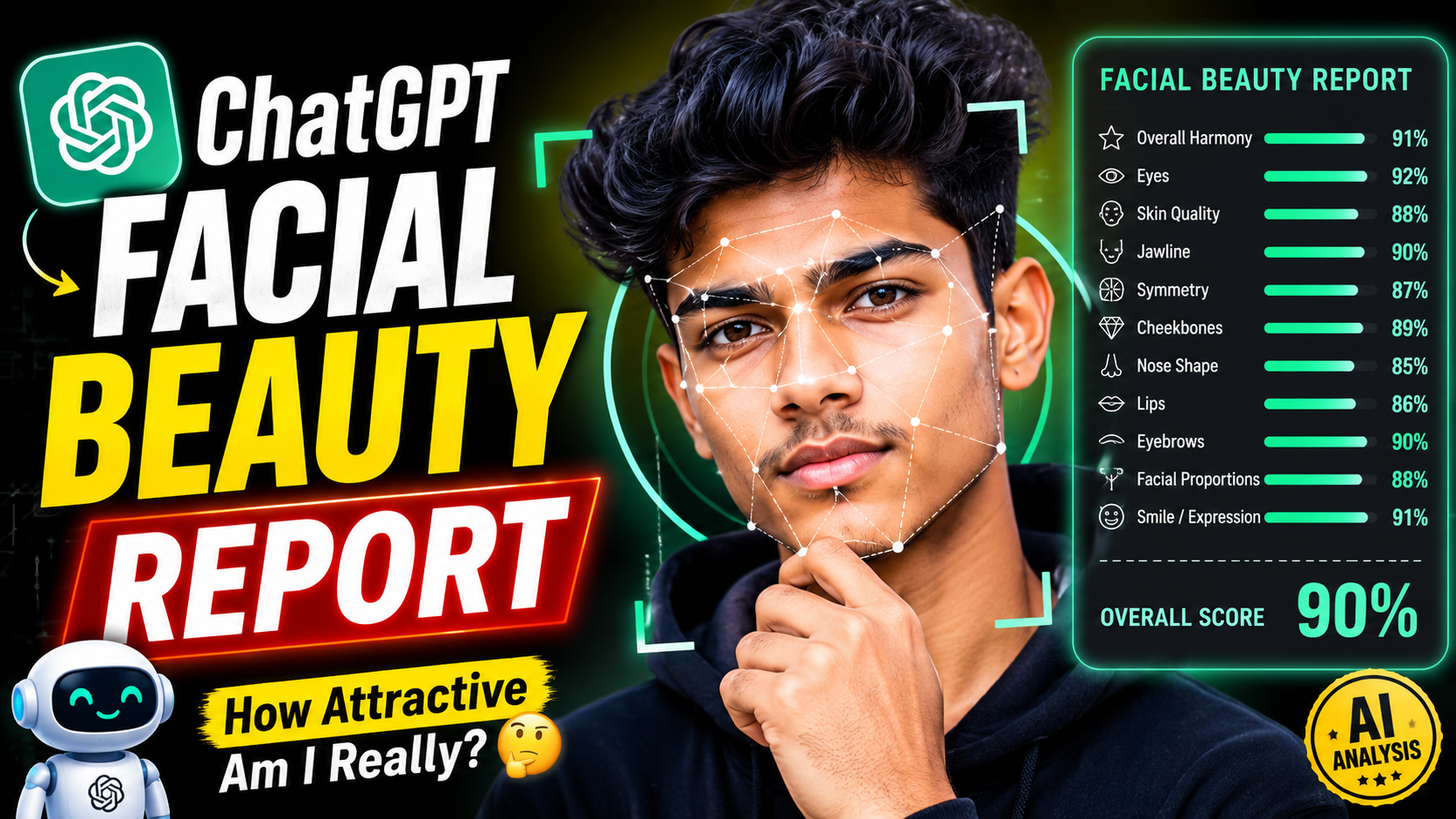
Searches for ChatGPT facial beauty report are exploding. Many people want to upload a selfie, get a beauty score, and see detailed feedback about their face.
There are a few big problems:
- Most tools do not explain what they measure or how.
- Beauty scores are often based on narrow, biased standards.
- Uploading your face to random sites can create privacy and data risks.
This guide walks you through what facial beauty reports really are, what ChatGPT can and cannot do, and how to use AI image analysis in a safer, more constructive way on Android and iOS.
1. What People Mean by a Facial Beauty Report
Different apps and websites brand this feature in different ways, but they usually try to do some mix of:
- Facial symmetry scoring (left vs right side of the face)
- Proportion checks (distance between eyes, nose length vs face length, jawline shape)
- Skin quality guesses (smoothness, presence of spots or wrinkles)
- Style comments (hair, makeup, glasses, grooming)
What they don’t usually tell you clearly:
- What training data was used (which can reflect racial and gender bias)
- Whether the model was built for medical, cosmetic, or just entertainment
- How your photo is stored, reused, or combined with other data
FACE PROMPT LINK :-
CLICK HERE
So when you see a beauty score like 76/100, it is not an objective fact. It is a statistical guess based on someone else’s idea of attractiveness.
2. What ChatGPT Can (and Cannot) Do with Facial Images
Depending on the version and features available in your region, ChatGPT can sometimes work with images you upload. However, there are strict limits:
- It can describe visible features (e.g., short dark hair, wearing glasses).
- It can offer style suggestions (e.g., haircut ideas, makeup styles, glasses shapes) in a general way.
- It should avoid direct beauty scoring and harmful judgments about appearance.
- It does not diagnose medical or skin conditions and should not replace a dermatologist.
Think of ChatGPT image features as a tool for practical suggestions (hair, beard, outfit, skincare routines) rather than a judge of your looks.
3. Safer Ways to Use AI for Facial Feedback
If you want feedback without falling into the am I attractive enough? trap, focus on actionable, non judgmental prompts. For example:
- Given my face shape, what hairstyles generally work well?
- What types of glasses frames usually suit a round/oval/heart shaped face?
- What basic skincare routine works for someone with visible oiliness and occasional breakouts?
- What beard or stubble length usually flatters a fuller jawline?
When using ChatGPT with a photo (if available in your app):
- Upload a selfie where you’re comfortable being recognized and avoid including other people.
- Use a neutral prompt:
Example: Please describe my face shape in neutral terms and suggest 3 hairstyles and 3 types of glasses that typically work for that shape. - Avoid prompts like rate my beauty or how ugly am I. They encourage unhelpful and potentially harmful interpretations.
4. Android & iOS: Practical Setup and Privacy Checks
You can access ChatGPT and similar AI tools from both Android and iOS. Regardless of your device, treat your face photo like personal identity data.
4.1 Basic steps on Android
- Use the official ChatGPT app from Google Play or the official website in your browser.
- Avoid lookalike apps pretending to give AI beauty ratings with no privacy policy.
- Open the app > sign in > check Settings → Data controls (exact name can vary by version).
- Review how your data may be used for training.
- Disable features you are not comfortable with, if available.
- Before uploading any selfie:
- Avoid photos with your address, ID cards, or screens in the background.
- Do not include children or other people without permission.
4.2 Basic steps on iOS
- Download the official ChatGPT app from the Apple App Store or use Safari/Chrome to access the official site.
- In iOS Settings:
- Go to Settings → Privacy & Security → Photos and review which apps have access.
- Set apps you don’t fully trust to Selected Photos instead of full library access.
- Inside the ChatGPT app, review:
- Data controls (if available in your version).
- Any Labs / Beta options related to images.
5. Common Mistakes When Using Facial Beauty Tools
Here are typical pitfalls and how to avoid them:
| Mistake | Why It’s a Problem | Better Approach |
| Uploading selfies to random beauty score sites with no information. | Your images may be stored, sold, or reused for training without clear consent. | Stick to tools with transparent privacy policies. Limit where your face data goes. |
| Taking beauty scores as objective truth. | Scores are based on biased datasets and narrow standards. | Use AI for style tips, not self worth. Treat scores, if shown, as entertainment only. |
| Asking AI if you are ugly, too dark, too old, etc. | Reinforces negative self talk and can trigger harmful responses. | Ask neutral, constructive questions about grooming, skincare, or styling. |
| Assuming AI can spot medical or mental health issues from your face. | AI is not a doctor or therapist; misinterpretation can delay real help. | Consult qualified professionals for health concerns; use AI only for general information. |
| Sharing minors’ faces for cute rating or future face predictions. | Raises serious privacy and consent issues, especially with unknown services. | Avoid uploading children’s faces unless the tool is clearly designed and approved for that use. |
6. How to Structure Better Prompts for Face Related Advice
If your main interest is improving your appearance in a healthy, practical way, shift from Am I beautiful? to What can I try?
6.1 Example prompts without a photo
- Face shape questions: If I have a round face, what kinds of haircuts, beard styles, and glasses are usually recommended?
- Skincare routine: My skin is oily and acne prone. Suggest a simple morning and night routine using generic product types.
- Grooming for men: List 5 common grooming habits that improve appearance for men in office jobs.
- Makeup basics: Create a beginner friendly everyday makeup routine for combination skin and glasses wearers.
6.2 Example prompts with a photo (if allowed in your region)
When the app supports images, you can still keep things neutral:
- Based on this image, how would you describe my face shape? Please stay neutral and avoid judging attractiveness.
- Looking at my hairstyle and glasses here, suggest 3 small style changes that could give a more polished look.
- Can you suggest a simple, gender neutral skincare routine that might help with the visible oiliness in this photo?
7. Mental Health & Body Image: Important Warnings
Any tool that evaluates your appearance can affect mental health, especially if you already struggle with self esteem or body image.
- If a beauty score makes you feel worse, stop using that feature.
- Do not compare your score with friends or share it on social media as a measure of worth.
- Remember that AI can be more biased than real people because it learns from limited data.
- If you often feel obsessed with changing your face, consider talking to a mental health professional instead of more AI tools.
Appearance focused AI should remain a small, optional helper for styling experiments, not a judge that tells you how valuable you are.
8. Quick FAQ
Is a ChatGPT facial beauty report official?
No. There is no official beauty score product from ChatGPT. Third party tools might combine AI models and use ChatGPT style branding or prompts, but they are separate services.
Can AI accurately judge how attractive I am?
Not in any universal or objective way. AI can only compare your facial features to patterns in its training data, which reflects specific cultures, time periods, and biases.
Is it safe to upload my face to AI tools?
Safety depends on the service. Treat your face data like sensitive information. Read the privacy policy, avoid unknown sites, and prefer tools that clearly explain how images are stored and used.
Can ChatGPT diagnose skin problems from a selfie?
No. AI tools can sometimes describe what they see, but they are not medical devices. For rashes, moles, or ongoing skin issues, see a dermatologist.
What is a better use of AI than beauty scoring?
Style suggestions, grooming routines, glasses and hairstyle ideas, skincare education, and camera/lighting tips for better photos are all more helpful than a numeric